Definition according to CIGRE TB 531 chap. 4.2.4.2
| Id | Method | Info |
|---|---|---|
| 1 | Link connecting two substations | Both ends of the underground link connect to substations with low grounding resistances. The short-circuit return current flows predominantly through the ground. The grounding resistance R is negligible, and the parameter Xₕ may be set equal to R ≈ 0. |
| 2 | Link between a substation and a overhead line without skywire | The underground link connects a substation (low grounding resistance) on one side to an overhead line without skywire on the other side. At the transition tower the grounding resistance R is the footing resistance of that tower. Since there is no skywire, the earth return path is dominant and Xₕ ≈ 0. The grounding resistance parameter may be neglected where the return current injected into the earth at the fault location is large. |
| 3 | Link between a substation and a overhead line with skywire | The underground link connects a substation (low grounding resistance) on one side to an overhead line with skywire on the other side. At the OHL/UGL transition, the grounding resistance R to consider is the resistance of the transition tower in parallel with the impedance of the skywire. The skywire provides an additional return path that competes with the ground, making the ground path less attractive. The short-circuit return current shares between the ground and the metal screens depending on the relative magnitudes of the grounding resistance and the skywire impedance. The parameter Xₕ ≈ R accounts for the screen bonding conditions at the link ends and should not be neglected in this configuration. |
| 4 | Siphon - overhead line without skywire | The underground link (siphon) connects two overhead lines without skywire. The grounding resistance R is the sum of the footing resistances at both transition towers. The short-circuit return current shares between the ground and the metal screens through these grounding resistances. Considering typical grounding resistances of several Ohms, the preferential return path is the ground, and Xₕ ≈ 0. This parameter may be neglected where the return current injected into the earth at the fault location is large. |
| 5 | Siphon - overhead line with skywire | The underground link (siphon) connects two overhead lines with skywire. The grounding resistance R is the sum of the grounding resistances at both transition towers, each in parallel with the impedance of the respective skywire. The short-circuit return current shares between the ground and the metal screens, but the skywire makes the ground path less attractive. If the grounding resistances at both ends are similar, the return current shares nearly equally between ground and metal screens. If the grounding resistance at one end is high, the return current flows predominantly through the metal screens. The parameter Xₕ, which accounts for the screen bonding conditions at the link ends, must not be neglected in this configuration and is approximately equal to R. |
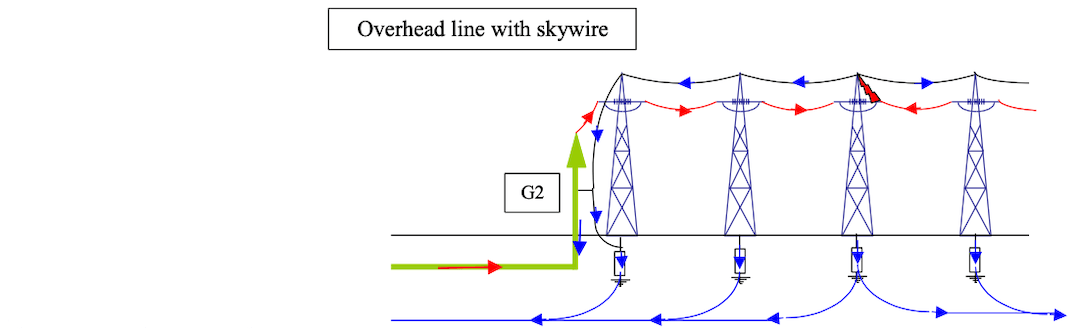
Case 2: CIGRE TB 531 (2013) Figure 25 upper (modified)
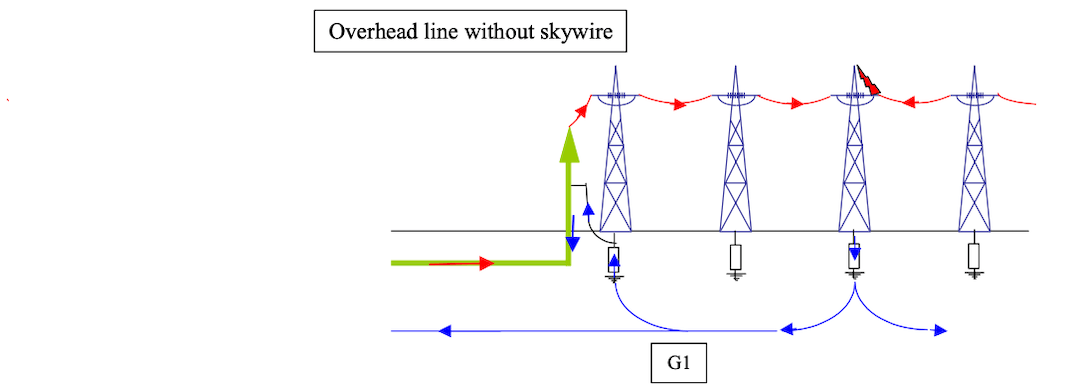
Case 3: CIGRE TB 531 (2013) Figure 25 lower (modified)
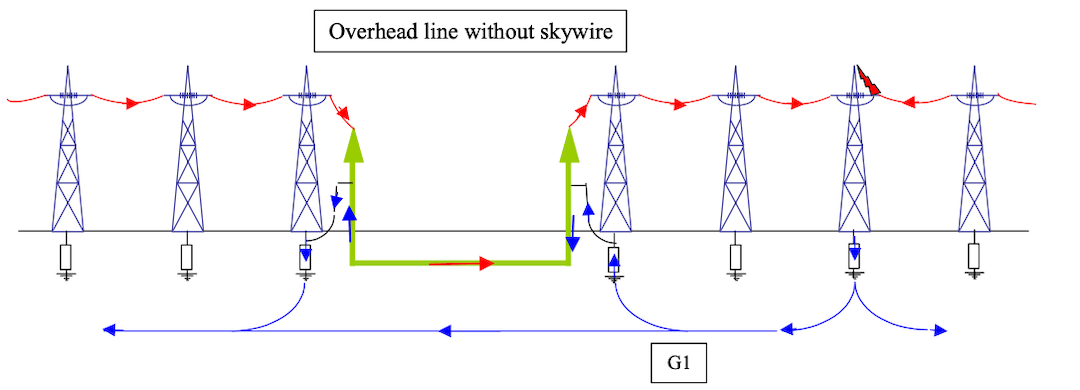
Case 4: CIGRE TB 531 (2013) Figure 25 upper
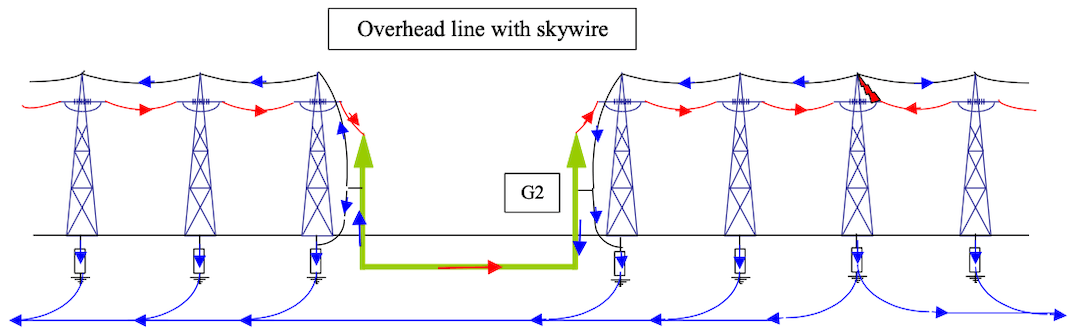
Case 5: CIGRE TB 531 (2013) Figure 25 lower