 ®
®
®
®
The cable drum calculator helps you to determine the length of cable of a certain type which fits onto a specific cable drum and it calculates the total weight.
Posted 2026-01-05
Categories:
Tools
The cable drum calculator is based on a spreadsheet tool originally developed by the manufacturer Brugg Cables from Switzerland to calculate the capacity of a cable defined by its diameter on standard drums. In addition it also provided a method to calculate the capacity for user-defined drums which is what has been transformed to this tool.
With the input of the weight per meter of the cable it calculates also the total weight of the cable on the drum. And based on publicly available data for different drum sizes the weight of the user-defined empty drum is approximated in order to get the total weight of cable and drum, a useful information for a transport study.
This code reads the current drum and cable dimensions from the user session, calculates how many cable windings and radial layers can fit on the drum, and then estimates the total cable length that can be wound onto the drum. It also computes the remaining unused space in width and radius.
All input dimensions are in millimeters (mm). The resulting cable length is in meters (m). The tool can also be used with US units.
D_e: Cable outer diameter (mm).D_flange: (DA): Drum flange outer diameter (mm).D_core: (DK): Drum core / barrel diameter (mm).D_bore (A): Bore diameter (mm) used for the drum drawing/spec.D_wheel (E): Inner width / wheel dimension (mm) used for the drum drawing/spec.w_drum (B): Overall drum width (mm).w_wind (C): Usable winding width between flanges (mm).d_free: Free clearance margin (mm). This keeps cable away from the flanges/core limits.method: Filling method (string), e.g. "wild", "full", or another mode.num_layers) is computed from the free radial space:
(D_flange - D_core - 2 * d_free) / 2 (mm).
This is because diameters are converted to radius by dividing by 2, and clearance is applied on both sides.
D_e gives the number of cable layers that fit radially.
floor(...) ensures the result is an integer that does not exceed the available space.
num_windings) is:
floor(w_wind / D_e).
This is how many cables of diameter D_e fit side-by-side within the usable winding width.
The code proceeds only if num_layers > 0 (at least one radial layer fits).
The length calculation uses a simplified model:
D_core + num_layers * D_e (mm).
(This represents winding on top of the core and building up by num_layers layers.)
π × diameter.
num_layers × num_windings.
1000 converts from millimeters to meters.
wild
L_cable is multiplied by 0.92 to account for imperfect packing
(random/wild winding does not fill space as efficiently).
space_w = 0 because the model assumes the usable width is effectively consumed by the winding behavior.
full (LV cable)
space_w = w_wind - num_windings * D_e (mm).
else Decrease by one winding (MV/HV cable)
num_windings by 1 before computing the length.
This models leaving one winding “column” empty (for example, due to practical constraints).
space_w = w_wind - num_windings * D_e (mm).
After placing num_layers layers radially, the unused radial clearance is:
space_r = (D_flange - D_core - 2 * num_layers * D_e) / 2 (mm).
This is the leftover distance (in radius) between the outermost cable layer and the flange limit.
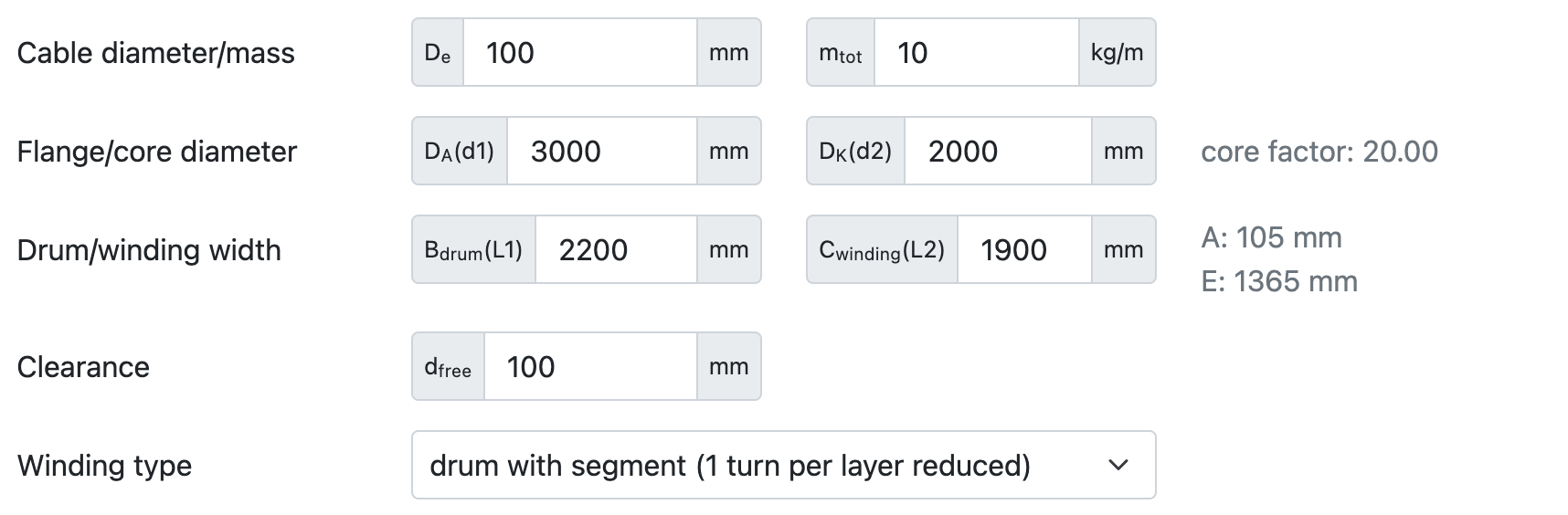
num_layers: Number of cable layers that fit radially (integer).num_windings: Number of windings that fit across the width (integer, possibly reduced by 1 in fallback mode).L_cable: Estimated total cable length that fits on the drum (meters).space_w: Remaining unused winding width (mm).space_r: Remaining unused radial space (mm).Let us run a simple example with following inputs using the method 3 with decrease by one winding:
| Electrical field | Preview in editor |
|---|---|
 |
 |
The calculation returns the following results:

The data for a list of empty drums is taken from the 'Manual for Transportation and Cable Laying' by Brugg Cables.
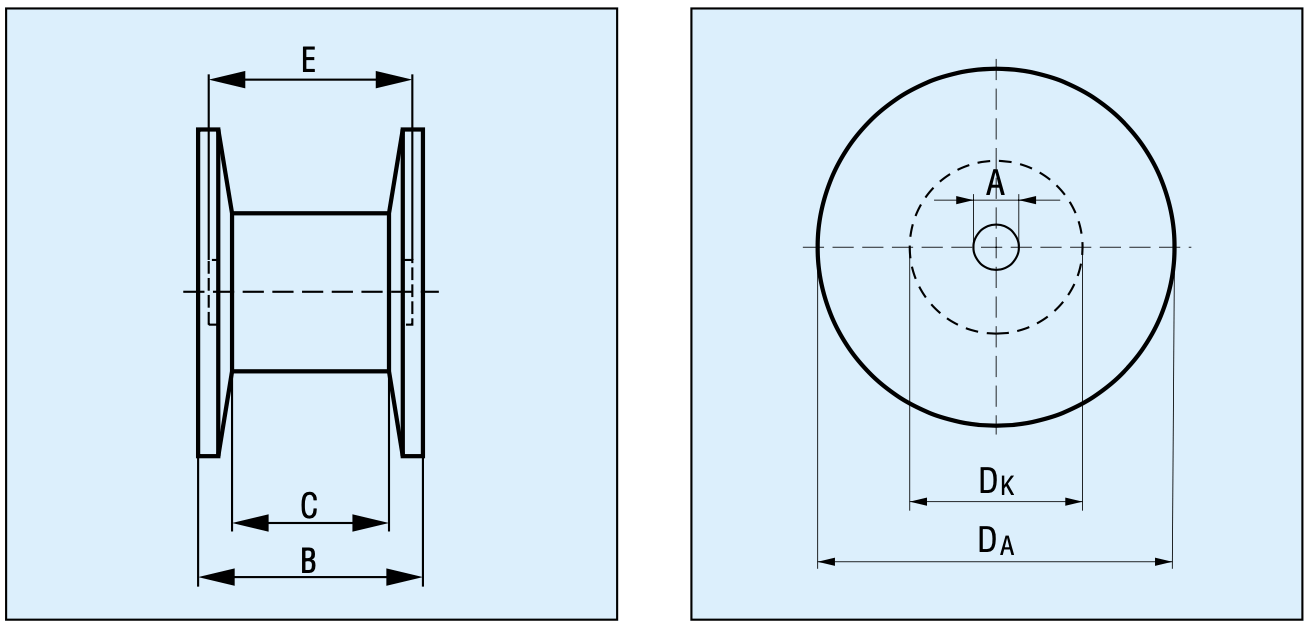
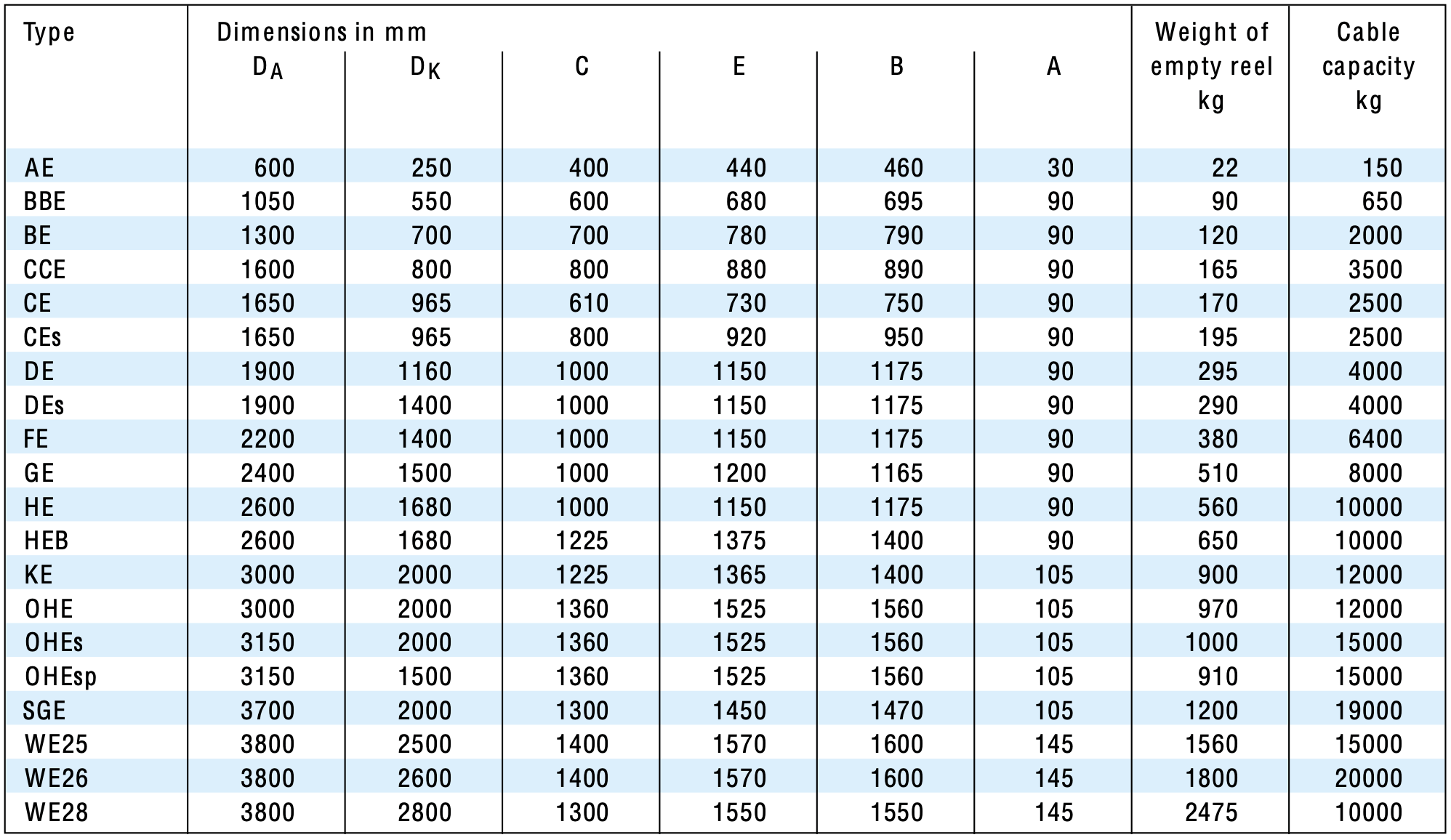
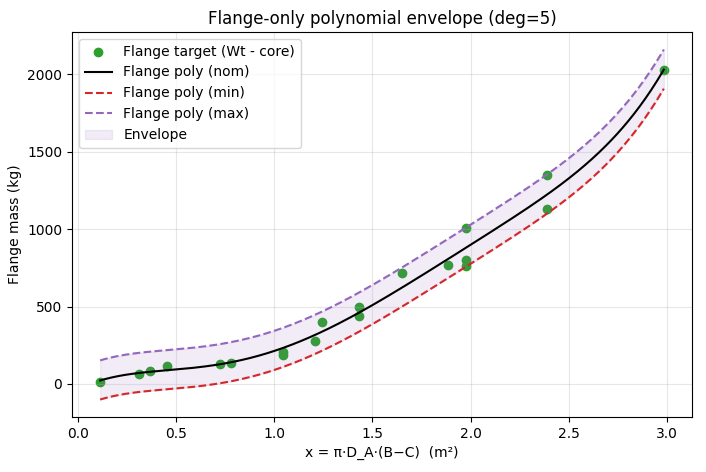
From this data we created a function to calculate the weight of a drum with any dimension up to a flange diameter of 5 m using a 5th degree polynominal best-fit including the min and max envelopes. The problem is that depending on the actual design of the drum and the ratio between core to flange diameter as well as the width there are jumps in the data.
| Polynominal envelopes | Actual vs predicted values | Extrapolation |
|---|---|---|
 |
 |
 |